
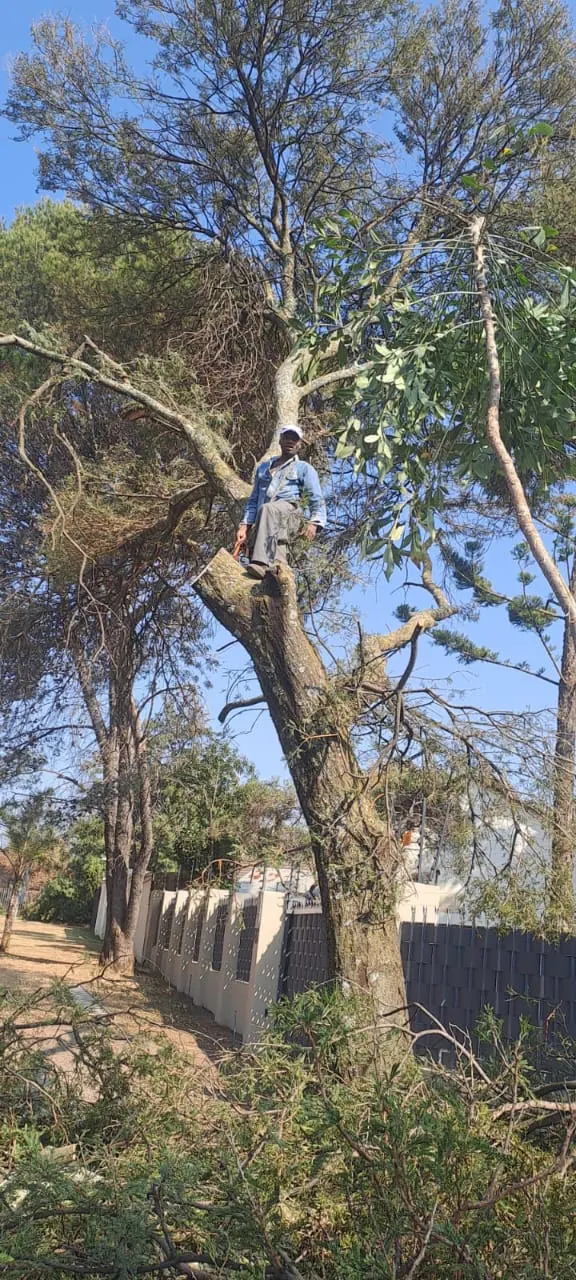
A felled tree leaves a stump, and a stump is more than an eyesore. It regrows, it attracts termites, it trips people and it stops you re-paving or replanting. Stump grinding is the fastest way to get the space back. Here is how it works in Gauteng gardens, what drives the price and when you might choose full removal instead.
What stump grinding actually does
A stump grinder is a machine with a spinning cutting wheel that chews the stump into chips, pass by pass, until it sits below the surface. For most residential stumps we grind 15 to 30 cm below ground level, which is deep enough to lay lawn, paving or a flower bed on top. If you plan to build or plant a new tree in the same spot, we grind deeper and remove more of the root plate.
The main surface roots are ground as well. Smaller roots further out are left to decay naturally in the soil, which they do within a few seasons without causing problems.
Grinding versus full stump removal
- Grinding is quicker, cheaper and far less disruptive. The machine fits through a standard garden gate and the job is usually done within an hour or two per stump.
- Full removal digs out the whole root ball. It is only worth it when something will be built exactly where the tree stood, or where a drain or foundation runs through the roots. It needs an excavator, leaves a large hole and costs several times more.
For nine out of ten Gauteng gardens, grinding is the right choice.
What affects the price
We quote per stump after seeing a photo or the site. The factors that move the price are:
- Diameter: measured at ground level, across the widest point including the flare. A 30 cm stump is a quick job; a one-metre bluegum stump is not.
- Species and age: hardwoods and old stumps take longer than young, soft-wooded trees.
- Access: a stump next to the driveway costs less than one behind the house up a flight of steps. Our compact grinder fits through a 75 cm gate.
- What is around it: paving, irrigation lines, walls and cables close to the stump slow the work down.
- Number of stumps: several stumps on one visit cost less each than one at a time.
Grinding is always cheaper when it is booked with the felling, because the team and the machine are already on site.
What happens to the chips
Grinding produces a surprising volume of wood chips mixed with soil. Most clients keep them: they make a good mulch for beds and paths once they have composted for a few weeks. If you would rather have them taken away, we remove them and backfill the hole with soil so the area is level and ready to use.
When to grind straight away
- The stump is from a species that coppices, such as poplar, wattle, syringa or bluegum. Left alone it will send up shoots within weeks.
- You have termites or wood borers in the area; a dead stump is an open invitation.
- The stump is in a lawn or play area where people, mowers or vehicles can hit it.
- You are selling the property. Stumps are one of the first things buyers and inspectors notice.
Can you plant a new tree in the same spot?
Yes, with a little preparation. We grind deeper, remove most of the chips and replace them with topsoil and compost, because fresh wood chips draw nitrogen out of the soil as they break down. Choosing a different species from the one removed also avoids any disease that may have affected the original tree.
Conclusion
Stump grinding is a small job that makes a big difference to how a garden looks and how safely it can be used. If you have a stump in Johannesburg, Pretoria, the East Rand or the West Rand, send us a photo on WhatsApp with something for scale and we will quote you the same day. Booked together with felling, it is the most cost-effective way to finish the job properly.